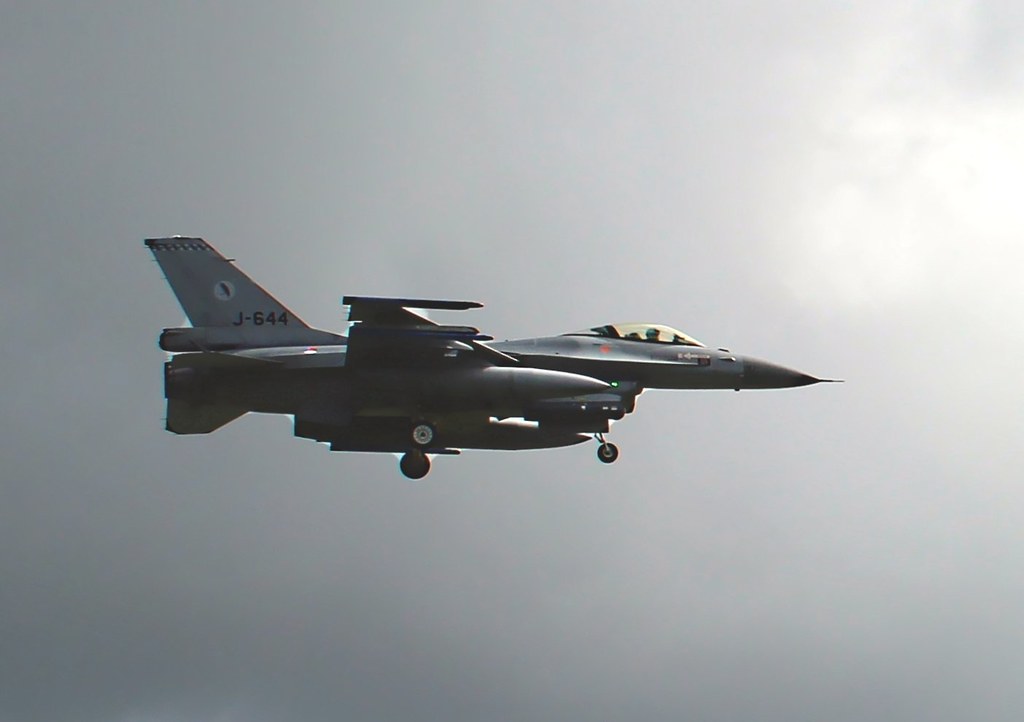
In July 2026, headlines around the world announced that artificial intelligence had flown a fighter jet. The story was real, but the details got flattened in the retelling. An AI-controlled F-16 did take to the sky over Florida — and there was a human pilot sitting in the cockpit the whole time.
Here is what actually happened, what the AI was allowed to do, and why the part everyone worries about — machines choosing targets — is not what this test was about.
What actually happened at Eglin Air Force Base?
On 16 July 2026, DARPA and the U.S. Air Force announced that a modified F-16 Fighting Falcon had flown at Eglin Air Force Base in Florida with an onboard AI agent in control of the aircraft for portions of the flight. A human test pilot remained in the cockpit as a safety monitor. It was the first real-world flight of the aircraft under the VENOM programme.
The build-up was deliberate and slow. Flight operations began in June 2026 with ordinary piloted sorties, purely to confirm that the new hardware and software behaved safely in the air. Only after that did the programme hand portions of a flight over to the AI agent.
The milestone was not that a jet flew itself — it was that a production fighter aircraft was successfully converted into a platform where AI agents can be swapped in and tested safely.
Was there a pilot in the cockpit of the AI-controlled F-16?
Yes. A qualified Air Force test pilot sat in the cockpit for the entire flight, monitoring the AI agent and able to take control instantly. The aircraft was never empty and never uncrewed. The pilot’s job shifted from flying the jet to supervising the software that was flying it.
This distinction matters because it is the single most misreported part of the story. Social media versions of the news dropped the pilot entirely, which turned a careful engineering test into something that sounded like a scene from a film.
The same supervised approach shows up wherever AI touches aviation. Even in civilian airspace, the systems that help controllers sequence aircraft in bad weather are advisory — a human still makes the call, much like the tools we covered in how AI helps air traffic control land planes in fog.
What is the VENOM programme?
VENOM stands for Viper Experimentation and Next-generation Operations Model. It is a joint U.S. Air Force and DARPA effort that converts a small group of F-16s into flying testbeds for autonomy software. “Viper” is the pilots’ nickname for the F-16.
The conversion is done with something called the VENOM Autonomy Kit, or VAK. The kit is hardware and software that plugs into the jet’s existing flight controls and mission systems, giving an AI agent a controlled, instrumented way to fly the aircraft — and giving engineers a controlled way to shut it off.
VENOM’s real product is not an autonomous fighter jet; it is a repeatable test bench for autonomy in a real aircraft at real speeds.
VENOM sits alongside two related DARPA efforts:
- ACE (Air Combat Evolution) — the earlier programme that built trust in AI dogfighting, including flight tests aboard the X-62A VISTA aircraft, where an AI agent flew close-in air combat manoeuvres against a human-piloted F-16.
- AIR (Artificial Intelligence Reinforcements) — the follow-on effort, which will test multiple competing AI agents in live flight and scale up to beyond-visual-range, multi-aircraft scenarios.
“These groundbreaking flight tests of VENOM-modified F-16s advance infrastructure for trusted autonomous air combat capabilities,” said Brig. Gen. James “Fangs” Valpiani, the DARPA programme manager, who also noted that AI has “tremendous potential to help humans manage complexity in beyond-visual-range combat.”
Does the AI decide when to fire?
No. The VENOM tests are about flying the aircraft, not employing weapons. Under U.S. policy, autonomous and semi-autonomous weapon systems must be designed so that commanders and operators can exercise appropriate levels of human judgment over the use of force. Target selection and engagement remain human decisions.
That rule comes from Department of Defense Directive 3000.09, first issued in 2012 and updated in January 2023. Critics point out that “appropriate levels” is a flexible phrase rather than a hard line, and that debate is genuinely unsettled — but the directive is why an AI agent flying a test sortie is a very different thing from an AI agent authorised to shoot.
The concern that AI systems behave unpredictably when given more freedom is not paranoia, and it is being studied seriously in civilian contexts too — see our write-up of what the UK’s rogue AI agent safety tests really found.
Why is the Air Force doing this at all?
The short answer is drone wingmen. The U.S. Air Force is building a fleet of Collaborative Combat Aircraft (CCA) — uncrewed jets designed to fly alongside crewed fighters, carrying sensors and weapons, and taking on the missions that are too risky or too numerous for piloted aircraft.
Two prototypes are already flying. General Atomics’ YFQ-42A, later named Dark Merlin, made its first flight in August 2025. Anduril’s YFQ-44A, nicknamed Fury, followed on 31 October 2025. In June 2026 the Air Force selected both designs for an initial production contract covering a combined 150 aircraft by 2030. The programme has not been trouble-free — a YFQ-42A was lost in a mishap in April 2026.
For that fleet to be useful, one human pilot needs to be able to command several autonomous aircraft at once without micromanaging them. That is exactly what Lt. Col. Patrick “Dice” Highland, the incoming AIR programme manager, pointed to: the opportunity, in Highland’s words, to “create dominant autonomy for beyond-visual-range, multi-ship combat.”
The F-16 is not the destination — it is the safest available classroom for software that will eventually fly aircraft with nobody on board.
Will AI fly passenger planes next?
Not soon, and not in this form. Military test aviation and commercial aviation run on completely different risk models. A test squadron can accept a mishap rate that would be unthinkable for an airline, and military certification does not have to satisfy civil regulators such as the FAA or EASA.
What is realistic in the next decade is more autonomy inside the cockpit rather than instead of it: better automatic collision avoidance, AI-assisted emergency handling, and single-pilot cargo operations with heavy machine support. Airliners already fly most of a route on autopilot — the hard part was never the flying, it is the judgment when something goes wrong.
What this story actually tells you
Strip away the headline and three things are left. First, AI can now handle the physical task of flying a high-performance fighter well enough to be trusted in a supervised test. Second, the institutions running these tests are moving cautiously, with a human aboard and weapons release firmly out of scope. Third, the real programme is not about replacing fighter pilots but about giving each one a squad of machines to direct.
The genuinely open question is not whether AI can fly the jet. It clearly can. The question is how much judgment gets delegated next, and who decides where that line sits.
Frequently Asked Questions
Did AI really fly an F-16 fighter jet?
Yes. In July 2026, DARPA and the U.S. Air Force flew a modified F-16 at Eglin Air Force Base with an onboard AI agent controlling the aircraft during portions of the flight. A human test pilot was in the cockpit throughout as a safety monitor.
Was the AI-controlled F-16 flying without a pilot?
No. The jet was never uncrewed. A qualified test pilot remained in the cockpit, monitoring the AI agent and able to take back control at any moment. The programme has not flown an F-16 with an empty cockpit.
What does VENOM stand for?
VENOM stands for Viper Experimentation and Next-generation Operations Model. It is a joint U.S. Air Force and DARPA programme that fits F-16s with the VENOM Autonomy Kit so AI agents can be tested in real flight.
Can an AI fighter jet fire weapons on its own?
Not under current U.S. policy. Department of Defense Directive 3000.09 requires that commanders and operators retain appropriate levels of human judgment over the use of force. The VENOM flight tests focus on flying the aircraft, not on weapons employment.
Will AI replace fighter pilots?
The current plan is teaming, not replacement. The U.S. Air Force is developing Collaborative Combat Aircraft — uncrewed jets that fly alongside crewed fighters — so that one human pilot can direct several autonomous aircraft at once.