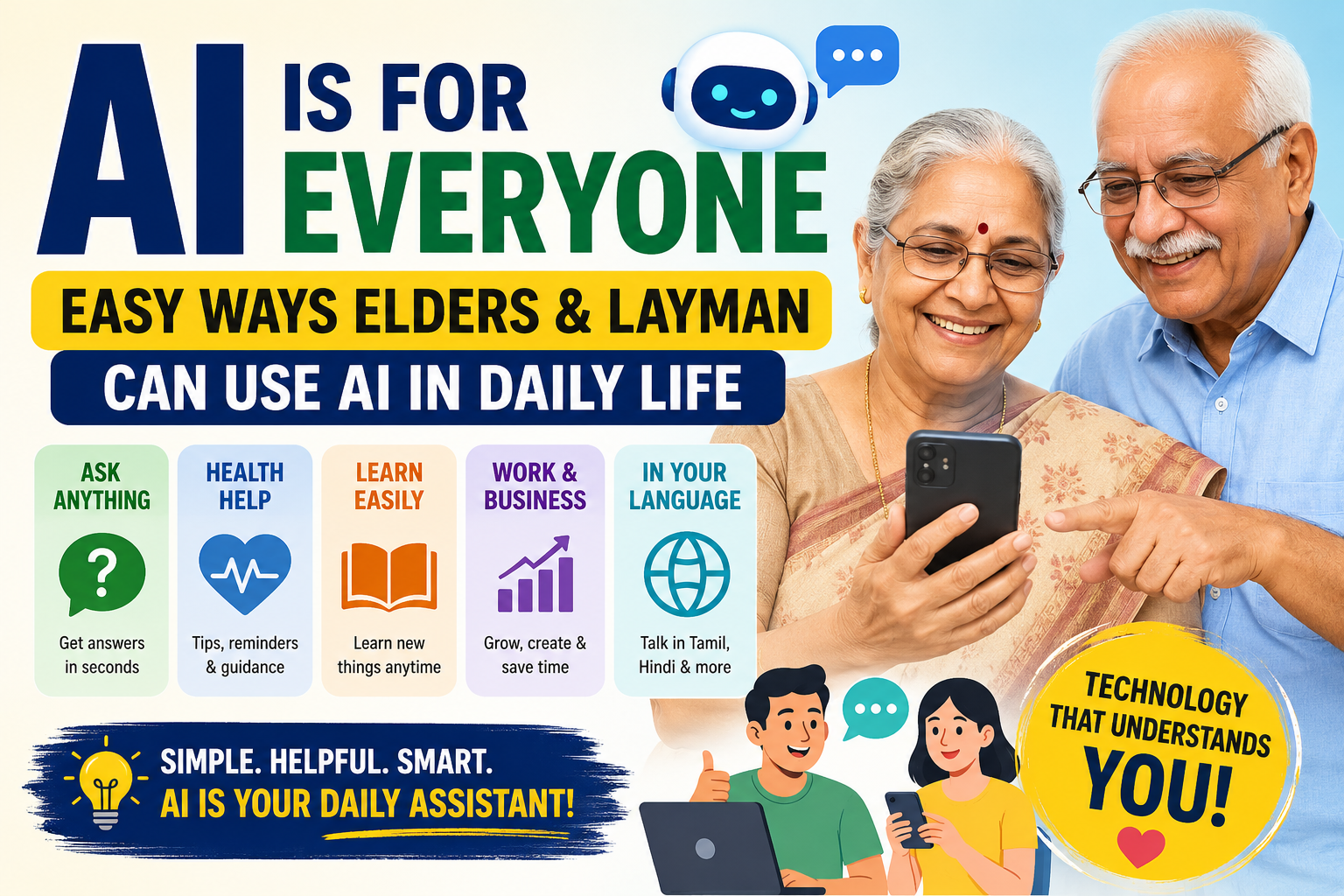
A few years ago, people thought Artificial Intelligence (AI) was something only scientists, programmers, or big companies could use. But today, AI has become simple enough for everyone – including parents, grandparents, shop owners, students, homemakers, farmers, and retired people.
You don’t need coding knowledge.
You don’t need expensive computers.
You only need a smartphone and curiosity.
AI is slowly becoming like Google, WhatsApp, or YouTube – a daily-use tool that can save time, reduce stress, and make life easier.
What Exactly Is AI?
AI is like a smart assistant that can:
- answer questions,
- translate languages,
- help write messages,
- explain difficult topics,
- create images,
- read documents,
- and even talk like a human.
Instead of searching through hundreds of websites, you can simply ask AI directly.
For example:
- “Explain diabetes in simple Tamil.”
- “Write a birthday wish for my friend.”
- “Translate this English message to Tamil.”
- “How to grow tomatoes at home?”
- “Help me understand my electricity bill.”
AI will answer within seconds.
How Elders Can Use AI in Daily Life
Many elderly people struggle with smartphones, online forms, English language, or searching the internet. AI can make these things much easier.
1. Reading and Understanding Messages
Sometimes bank messages, hospital reports, or government notices are difficult to understand.
An elder can simply copy the text into AI and ask:
“Explain this in simple language.”
AI can simplify complex information instantly.
2. Health and Medicine Reminders
AI can help explain:
- medicine timings,
- food restrictions,
- exercise tips,
- walking routines,
- and healthy meal ideas.
It can also help create reminder schedules.
3. Learning Technology Slowly
Many seniors fear technology because they think they may “break something.”
But AI allows them to ask simple questions without embarrassment:
- “How to use Google Pay?”
- “How to make a video call?”
- “How to book train tickets?”
AI responds patiently every time.
4. Fighting Loneliness
Some elderly people use AI just to talk, ask questions, hear stories, or learn new things. While AI cannot replace human relationships, it can still provide companionship and mental engagement.
How Common People and Small Businesses Can Use AI
AI is becoming a powerful helper for ordinary people.
Shop Owners
A small tea shop or clothing store owner can use AI to:
- create poster text,
- write WhatsApp promotions,
- generate Instagram captions,
- and create business ideas.
Farmers
Farmers can ask:
- crop suggestions,
- weather-related tips,
- fertilizer guidance,
- pest control ideas,
- and market trends.
Students
Students can use AI to:
- understand difficult lessons,
- solve doubts,
- practice spoken English,
- create presentations,
- and prepare for interviews.
Homemakers
AI can help with:
- recipes,
- monthly budgeting,
- health tips,
- school project ideas,
- and home business planning.
AI Can Speak Your Language Too
One big reason AI is becoming popular in India is language support.
People can now type or speak in:
- Tamil,
- Hindi,
- Telugu,
- Kannada,
- Malayalam,
- and many other languages.
This removes the fear of English.
A grandmother in Chennai or a farmer in a village can ask questions in their own language and still get useful answers.
Important Advice – Use AI Smartly
AI is powerful, but people should use it carefully.
Always remember:
- Don’t share passwords or bank OTPs.
- Double-check medical or financial advice.
- Use trusted AI apps and websites.
- Treat AI as a helper, not as a replacement for human thinking.
The Future Is for Everyone
Earlier, technology mainly helped educated people in cities.
But AI is different.
AI is slowly becoming a tool for everyone:
- young and old,
- educated and non-educated,
- urban and rural people alike.
The biggest change is this:
People no longer need to “learn computers deeply” to use technology.
Now technology is learning to understand humans.
That is why AI may become one of the most useful inventions for ordinary people in the coming years.